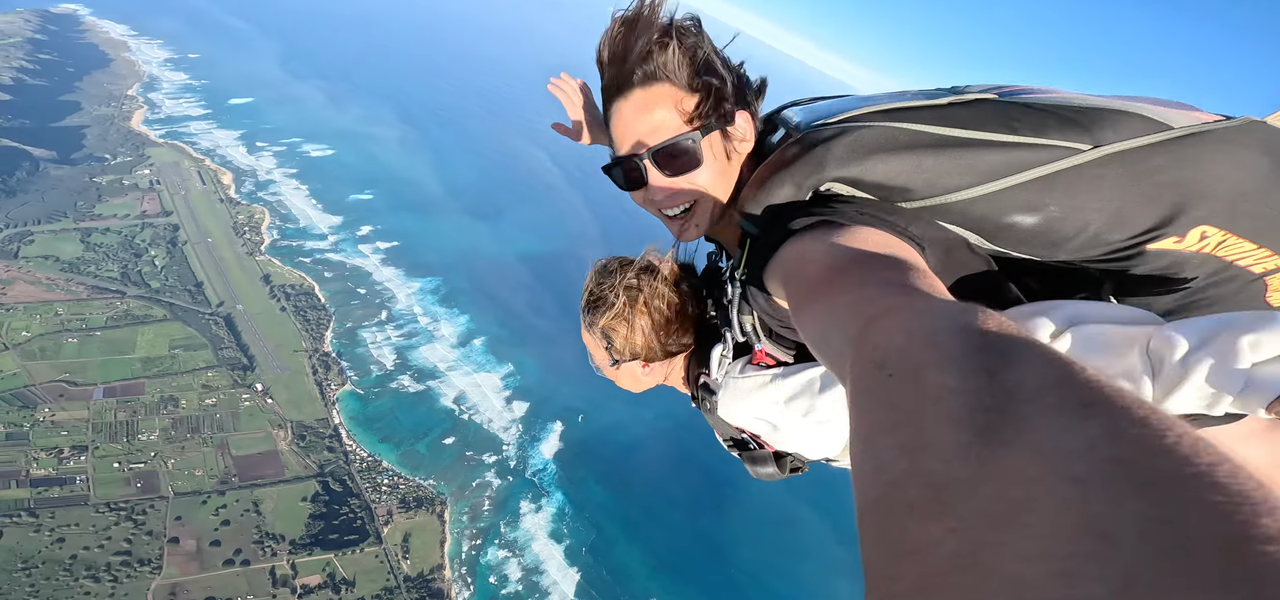
This blog is even better if you watch the youtube video it’s paired with
Contents
- How to become a tandem skydive instructor + cost & timeline
- How much tandem skydivers get paid
- A dive into their schedule, lifestyle, pros cons and more
How to become a USPA tandem skydiver (Tandem Instructor)
Cost: $25,000 - $45,000 Timeline: 3-6 years
Pay for a Tandem Jump at a dropzone, make sure you love it enough to do it professionally.
Attend an AFF program (Accelerated Freefall)
- Costs $3,000-$5,000, including everything
- 1-12 weeks (at your pace)
- This is the course where you learn the basics
- You’ll attend ground school, then start jumping.
- At first you’ll have instructors skydiving next to you, ensuring you get stable and properly deploy your parachute. You’ll have a radio on you so when you fly your landing pattern, you have some guidance
- You’ll work your way up to jumping and landing safely without a radio or instructor
- Build jumps and get your A license
A license Reqs:
- Be 18+ years old
- 25+ jumps
- Pass written exam
- Pass oral exam
- Pass evaluation jump
- Complete Progression card
- Be a current USPA member in good standing (applies to all future licenses/ratings)
From here on out, jump as much as possible and work towards your next licenses
- Drop zone lift tickets (the ride into the sky) usually run $25-$40 per jump.
- Consider buying your own skydiving rig, helmet, altimeter ($5,000-$13,000+), rental gear runs $70+ per day.
- Consider getting a job packing parachutes at the dropzone. You’ll be able to start making money, jump once or twice a day, and increase your knowledge
Next, attain:
B license. Reqs:
- 50+ jumps
- 30+ minutes of controlled freefall time
- On 10 jumps, land within 33 feet of a target center
- On 10 jumps, pre-plan and complete a formation in freefall, with 5 jumps involving 3 or more participants
- Take water training
- Pass written exam
- Complete Canopy Proficiency card
Consider getting your coach rating when you hit 100 jumps. You’ll need this rating or higher to get your tandem instructor rating
- Time/cost: 3 days (typically), $500 - $1,000
- This rating enables you to get paid to train and jump with students, teach parts of the solo first jump course and jump with jumpers doing their recurrency jumps
- Prerequisites: B license, 100+ jumps and must have assisted in a first jump course and pre-course exam
C license
- 200+ jumps
- 60+ minutes of controlled freefall time
- On 25 jumps, land within 7 feet of a target center
- On 50 jumps, preplan and complete a formation in freefall, with 10 jumps involving 4 or more participants
- Pass written exam
D license
- 500+ jumps
- 180+ minutes controlled freefall time
- Complete 2 of the following
- On 100 jumps, land within 7 feet of a target center
- On 100 jumps, pre-plan and complete a formation in freefall, with 25 jumps involving eight or more participants
- A full ‘rotation’ of a canopy formation of three or more participants, starting and ending at the same position at least once
- An intentional water-landing jump
- An intentional night jump
- Pass written exam
Attain your Tandem Instructor Rating
- 3-5 days, $850 - $5,000 cost
- This qualifies you to jump with tandem passengers (someone attached to you), and teach tandem jumping to students. This course is manufacturer specific, meaning if you will be jumping Sigma, you must be rated on their system.
- Reqs:
- D license (500+ jumps w/ ram-air canopy)
- 100+ jumps w/ ram-air canopy in last 12 months
- USPA Coach rating or higher
- 3 years in the sport
- Current Class III medical (physical exam, costs around $200)
Pay
Bottom line: Expect to make between $42.5k and $75k per year as a tandem skydiving instructor
You *generally* make $35-$50 per tandem jump including tip after paying for seat
- How: $35-$40 per jump from the company (avg) plus $20-$30 per jump in tips (avg) minus $20 for your seat in aircraft (everyone including instructors have to pay for their seat)
If you jump 4x per day, 5 days per week, 50 weeks/year
- 20 jumps x $42.5 per jump = $850/week
- $3,540/month, $42,500/yr
5x per day, 5 days per week, 50 weeks/year
- 5 x 5 = 25 jumps/week
- 25 jumps x $42.5 per jump = $1,060/week
- $4,420/month, $53,000/yr
5x per day, 6 days per week, 50 weeks/year
- 30 jumps x $42.5 per jump = $1,275/week
- $5,310/month, $63,750/yr
5x per day, 6 days per week (higher tips/company pay)
- 30 jumps x $50 per jump = $1,500/week
- $6,250/month, $75,000/yr
If you’re at a slow dropzone that has a lot of weather days, you might not even make $35k/yr. If you jump a lot at a busy dropzone with wealthy passengers, you may hit $75k/yr. Heavily dependent on DZ location, jump volume and how well passengers tip.
- Tandem instructors are usually independent contractors and often have an LLC they use to write off jumping-related expenses
- Be prepared for the additional 15.3% self-employment tax contractors have to pay
- Plan to cover your own health insurance
- Go talk to the people working at your desired DZ for the most accurate info
Affordability
- Hawaii is very expensive, and living near the DZ on Oahu’s north shore is no exception
- A 1 bedroom apartment can easily cost $2,500-$3,500 / month
- If you’re single and live with roommates, this income should support you
- If you want to live alone and aren’t frugal, plan on adding a part time job
- If you have a family, you’ll definitely need another job / dual income
Pros
- You get to skydive all day (fun)
- Incredible views
- Lots of time outdoors
- Work with adventurous people
- Get to give people a really special experience
- Flexible work schedule
- You’re an independent contractor, don’t have a traditional boss
Cons
- Money may be tight depending where you live
- Weather dependent; bad weather = no jumps, no income
- Can be hard on your knees, back etc
- You pay for your own health insurance
- Lacks financial stability, if you roll your ankle and can’t jump for a month, you’re not making money
An Average day
- 8:00-8:15 - Show up
- Prep and inspect your gear
- 8:30-8:40 Start prepping your first jumper
- 8:55-9:00 First flight departs
- Jump, drop chute, grab a new one, repeat
- You typically have a 20 minute break between jumps unless you’re ‘turning’, which is where you jump back to back lifts
- There may be a short aircraft refueling break around noon
- 2-3pm Complete your last jump and head home
- Some days are very busy and can push until 4-6pm
- Some days there aren’t a high volume of guests and you’re done before noon
- Some days, bad weather cancels all jumps
- Some days, bad weather will delay jumps. You’ll wait a few hours and jumps may resume or be cancelled altogether.
Overarching Schedule
- Most tandem skydivers work 4-6 days per week. You can work as few or as many days as you want
- This is dropzone dependent
- Skydivers who are consistently working hard will be prioritized on the loadplan
- Dropzones in Hawaii are open year round, including holidays. Location & weather usually dictates a dropzone’s seasonality.
- Since skydivers work as independent contractors, there is less of a ‘boss-employee’ relationship and more of a family relationship. Not all companies operate this way but at Skydive Hawaii, you can work as little or as much as you want, take time off, stay home on holidays etc. If you have another job in the afternoons or weekdays there is a lot of flexibility.
Becoming a Tandem Instructor is ideal for people who are
- Fun-loving
- Outgoing
- Enthusiastic
- Good with people
- Calm under pressure
Danger Score
- 6/10. Underwater welding is a 10/10, and an office job is a 1/10.
- Skydiving is like driving a car. You can drive your car slowly and safely, or you can drive it like a maniac. If you push the limits too hard, you can hurt yourself. Landing safely requires skill and sound judgement. Even still, on your journey from zero jumps to thousands, expect to have a few rough landings as you build experience.
- Other skydivers in the air can be a risk. If you’re flying your landing pattern and an inexperienced jumper is flying like a knucklehead, you may have to avoid a collision.
- Parachute malfunctions are rare but are a consideration. Malfunctions are when you pull your parachute and there is an issue. The chute may only deploy half way, may get caught around a leg or have a knot in one of the lines. To mitigate this, the parachute is equipped with a cutaway system that jumpers can use that physically cuts away the old parachute and deploys the reserve parachute. There is even a device which will auto-deploy the reserve in the event the jumper is unable to. Extensive training and backup devices mitigate this risk well.
Where I gathered info from
- Luca is a tandem skydiving instructor with Skydive Hawaii, basejumper, wingsuiter and Hawaii native. He’s worked at multiple dropzones on the mainland and in Hawaii, and started out as a parachute packer. He’s been jumping since he turned 18 seven years ago and has over 5,000 jumps under his belt. When he’s not jumping for work he’s wingsuiting in Europe, surfing or doing calisthenics.
- Jordan is the office manager for Skydive Hawaii, which conducts 20,000 tandems in a busy year. His job is to make sure everything is running smoothly and sometimes fills in and flies as a videographer. He’s been in the skydiving world for 14 years and is involved behind the scenes of the dropzone.
- Chris (me) is the author of this blog / host of DangerousJobs on Youtube. I did freefall / DBSL / static line jumps onto land and water every few months while I was a pararescueman (PJ) in the military. My goal is to give you some ballpark numbers and expectations so you can decide if you want this job. If anything is incorrect, please shoot me a DM on IG to correct it! IG: Chris.barnett_
Reminder: These details vary greatly. Go talk to the people at your desired drop zone to see how it is. The point of this is to put you in the right ballpark and help you make an informed decision about your future!
Huge thank you to Luca, Jordan and Skydive Hawaii for having me out!
Everyone to follow on socials:
Luca Battles IG: luca.battles Youtube: @LucaDiBeppo
Dangerous Jobs IG: Dangerousjobs_ Youtube: @Dangerous_Jobs
Chris Barnett
USPA licensing references
https://www.uspa.org/members/licenses/a-license-requirements-and-forms
https://www.uspa.org/members/licenses/b-c-and-d-license-requirements-and-forms