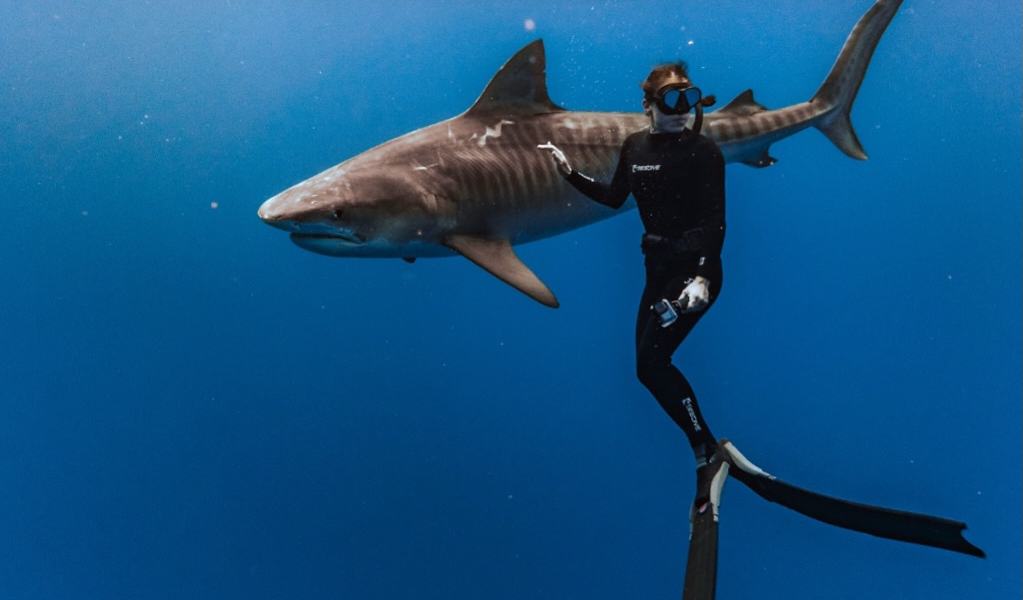
Collaborator: Mariana Perez-Varona. IG: mariana.perezvarona
Author: Chris Barnett. IG: dangerousjobs_
Contents
- A realistic look into the life of a shark safety diver
- Exact steps to become a shark safety diver
- A dive into their pay ($60k - $82.5k) and if that's enough to support you in Hawaii
About Mariana:
- Mariana is a 32 year old marine biologist and shark safety diver based on the North Shore of Oahu, Hawaii. She lived in Africa and was part of research projects that focused on Great White sharks, whale sharks, mantas, and other marine species. She also worked in coral restoration and at a penguin hospital. She worked full time as a shark safety diver, and now she balances life as a part time shark safety diver with her other occupations and hobbies like canoe racing.
Baseline Info:
- Shark Safety Divers are crew members on shark tours that are responsible for maintaining a safe environment during wildlife interactions
- They keep an eye on everyone in the water, and keep track of all sharks around the group
- They redirect 14-16ft tiger sharks with their hands, and teach guests how to conduct themselves in a safe manner
- They educate guests about sharks, conservation and how we can preserve our sea life
An average day (8-12 hours):
- Show up at 6am
- Prep the boat for the bay; masks, fins, fuel etc
- Conduct 3-5 small group charters per day. Each consisting of
- Teaching a lesson on the boat ride out about sharks and how to behave around them
- 40 minutes in the water w/ the sharks, keeping everyone safe, redirecting some sharks
- A lesson on the ride back about how we can protect our wildlife and oceans
- A 45 minute clean up at the end of the day
- Go home, 2-6pm
Most safety divers are:
- Marine biologists
- Freedivers
- Scuba divers (not necessarily instructors)
- Underwater photographers
- Spearfishermen
- Surfers
- Other sealife guides
- Ocean-passionate people
Requirements
- Certified Dive Master (required even for operating freediving tours, its an insurance thing)
- Ability to pass Divemaster medical exam
- CPR and first aid certification
- Strong swimmer
- Never get sea sick (Hawaiian waters will *rock* your world)
- Confidence & people skills
- *Preferred but not required: Marine biology degree (or be in college for this)
How to become a shark safety diver (from zero)
- Move to an area with shark tours (like Hawaii)
- Spend a substantial amount of your free time in the ocean. Start a water-based hobby that increases your water confidence puts you in proximity to sharks and other ocean life.
- Study sharks and their behavior so when you talk to companies you want to work with, your passion and preparation is apparent.
- Introduce yourself in person to as many shark tour operators as possible.
- Tell them who you are and your intentions.
- See what they specifically look for and require.
- Ask them what they would do if they were you.
- Make connections with anyone in the industry that you or your friends know.
- Network network network!
- Once you find a company you like with an entry level job or internship:
- Talk to people who work/have worked for that company in the past
- Make sure they conduct their operation ethically, treat their employees with respect and pay adequately
- Get a job doing anything for that company.
- You may start off working the front desk, loading the boat and doing support tasks. Since you don’t have much experience yet, use this time to build trust with the company and your coworkers.
- Make your way out on some of the charters and shadow a safety diver. Position yourself so that when a safety diver position opens up, you’re the obvious option.
Knock out your Dive & First Responder Certifications
- Fast, full-time timeline: 2-4 months
- Slower timeline: 4-12 months, diving on weekends/interning
- Overall cost: $3,000-$8,000 (expect the higher end in Hawaii)
- Look up all the shops providing dive instruction in the area you want to go, compare their packages and pick one. Claude/ChatGPT can whip up a pretty solid doc comparing different school’s cost, location, timeline etc for free.
- Price varies greatly based on your location. Getting your certs in Thailand will cost about half of what it costs in Hawaii, but you aren’t getting face time with the company you plan to work for.
Dive Certs you'll acquire
- Open Water Diver
- 3 days
- Advanced Open Water Diver
- 2 days
- Emergency First Responder (sometimes wrapped into Rescue Diver course)
- 1 day
- Rescue Diver
- 3-4 days
- Log dives on your own till you reach the 40 required to start divemaster. Expect to need 20-25 more dives after you've completed rescue diver.
- Timeline: 4 days - 2 months, depends on the program you choose.
- Dive Master
- 1 - 4 months if attending full time
- 4 -12 months if completing over weekends or via internship
- *1 month accelerated courses should only be considered by divers with extensive previous experience
- Internship Option: Consider ‘interning’ with a dive shop that teaches these courses. You trade your labor in exchange for discounted or free dives & certifications. Reach out to dive shops and see if they offer this.
- Pro move: If the shark tour company you want to work for offers dive instruction as well, work/intern with them!
Once you're a Divemaster
- Reach out to your company and other dive operations with your new certs
- Ideally, the company you started working/interning with has a safety diver position
- If not, physically go touch base with other tour operators and show them you're ready for work. It's easy for business owners to overlook emails you send, but hard for them to not consider you if you keep checking in, in person. Consider using Claude or ChatGPT to make a list of every shark tour operator on the island you’ve picked, and go show your face there once or twice a month.
- Once you get hired as a shark safety diver
- Expect to shadow a safety diver for a few weeks to a few months
- You’ll learn to become highly aware of your guests, the ocean life around you, develop teaching skills and physically practice redirecting curious sharks
- This ‘shadowing’ timeline varies company to company and depends on your other water experience
Schedule:
- Full time: 5 or 6 days per week, 6am till 2pm-6pm
- Part time: 1-3 days per week, 6am till 2pm-6pm
- Potential for later days ending closer to 7:30 pm for specialty tours
- Tours run year round in Hawaii. You may be scheduled on a holiday
- If you need to take time off you can, you’ll have to coordinate someone to cover for you
Full time income:
- Expect $60,000-$82,500 per year
- The going rate is about $100 per charter you dive on.
- Some companies pay closer to $75 per charter, but that’s below the industry standard (meaning you probably shouldn’t accept that)
- You can roughly expect an average of 3 charters per day, varies company to company
- $100 x 3 = $300 per avg day worked
- $300 x 5 = $1,500 per week x 50 weeks (factoring 2 unpaid weeks off) = $75,000/yr
- Base: $75,000/yr.
- Companies paying on the low end per charter = $56,250/yr
- Tips
- Some divers avg. $50 in tips per day
- Some divers avg. $5 in tips per day
- Some divers don't accept tips but have a higher base pay
- We're going to use $30/day
- $30 x 5 = $150 per week x 50 weeks per yr = $7,500/yr in tips
- Solid pay: $82,500. Fair charter rate, decent tips
- Low end: $60,000. Low charter rate, low tips.
- This is pre-tax and pre-health insurance (Additional expense(s) a normal W2 job would cover part or all of)
- Shark safety divers are almost always independent contractors in Hawaii, which is why health insurance is on you.
- These are ballpark figures. You may work more or less and get paid more or less. Contact the operator you want to work for to get their typical pay/charter volume.
Part time income: 2 days a week
- Expect $24,000-$33,000 per year
- $300/day x 2 = $600/week x 50 weeks per year (2 weeks off) = $30,000/yr
- Plus $30 x 2 = $60 per week x 50 weeks per yr = $33,000/yr
- Solid pay: $33,000/yr
- Low end: $24,000/yr
- Pre-tax, pre-health insurance
- Decent supplemental income but not enough to comfortably support yourself in Hawaii
Will shark safety diver income support you in Hawaii?
- Bottom line: working full time as a shark safety diver earns you enough to support yourself if you live a fairly basic lifestyle on Oahu.
- A bare bones apartment in Honolulu (60 min drive each way from the North Shore, where many dive operators are based) will set you back $1650-$2200/month after utilities.
- If you want to live very close to the North Shore and cut down your drive time, expect to pay much more
- Food and gas are expensive. It's an island. Nearly everything is imported.
- Many safety divers work two or three jobs. For example, some work as shark guides 4 or 5 days a week and do other eco-tourism and under photography jobs on the weekend. If the majority of people in the industry are working multiple jobs, you should expect to as well.
- If you have a family, an additional stream of income from a partner or another job would probably be necessary.
Pros
- You forget that you’re at ‘work’
- You get to dive with beautiful sharks and marine life all day
- In the right company, the culture and work environment is outstanding
- You get to meet really awesome people
- Pays well enough to live comfortably
Cons
- Your hours can be inconsistent. Some days end at 2pm, others at 6pm or later
- Working holidays is tough
- Exposure to the sun & salt water everyday wears down you body
- No health benefits
- Some companies pay the bare minimum, putting their employees in a tight spot financially
Danger Scale
- 4/10
- Working with 14ft- 16ft long tiger sharks takes skill and knowledge. The sharks are usually calm, but unpredictable guests (who may splash or freak out) can turn a peaceful encounter into a life changing one very quickly.
- If something goes wrong, it goes very wrong. But it happens so rarely that the danger rating remains relatively low.
- For example, in the years since the shark diving company Mariana works for opened for business, they’ve never had a bite.
- Almost all tour operators in Hawaii have never had a guest or employee bitten either.
What Mariana wishes she knew before becoming a shark safety diver:
- Learning and recognizing human behavior - like being able to tell when someone is about to freak out - is crucial for this job. She is more concerned with guests acting up than the sharks!
- Not all shark tour companies are created equal. Just because a company is crushing on social media does not mean they are ethical or upstanding in real life. Some companies engage in shady practices (like milking enthusiastic new employees for free work, paying the bare minimum, having a disrespectful work environment), so make sure you do your diligence, read contracts before you sign them and speak to former employees to determine if that's a business you want to work for.
Reality check:
- This is an incredible job! You get paid to spend time with sharks! But know:
- You will be in the ocean surrounded by sharks for hours a day, 5 days a week, year round.
- What comes with that: hard work, hours a day on the boat, repetitive tours, dealing with guests who can be stress-inducing, sun and salt water on you for most of the day.
- You'll be able to support yourself financially, but don't expect to have a ton of money left over.
- Breaking into this job can be tough. There are a lot of skilled and passionate watermen in Hawaii. Much of it comes down to timing and networking.
- There's a good chance that you will get all your certs and be ready to work, but will have to take another job until the companies start hiring again. If that happens, try to pick something adjacent to safety diving that continues to develop your water skills!
Now you have an idea of what it takes, and how it really is! Enjoy!
If you want to ask a question/leave a comment, we have the highest chance of seeing it if you leave the comment on the our Instagram video series posted by @dangerousjobs_ and @mariana.perezvarona. Posts will be live at the end of May.
Youtube Video: coming soon
Mariana's Instagram: mariana.perezvarona
Dangerous Jobs Instagram: @dangerousjobs_
Cover Image Credit: Michelle Gabriel
Chris Barnett
Founder and author, DangerousJobs.com